FamilyQuest
Gamified family task management that kids actually want to use
FamilyQuest
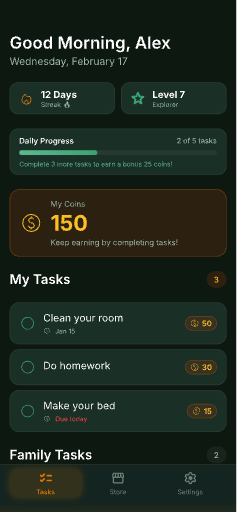
FamilyQuest turns household chores into something kids actually want to do, using the same reward loops that make games addictive, but applied to real-world responsibilities. Parents set tasks and rewards, kids earn coins and level up.
iOS + Web
Platform
Solo Developer
Role
From Idea to App Store
Product Design & Gamification
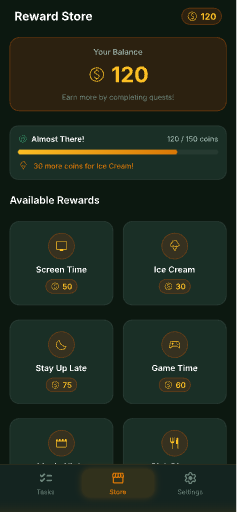
Designed a multi-layered gamification system: coins, XP/levels, streaks, and leaderboards. The reward store lets parents create custom rewards with coin costs, screen time, treats, activities.
TCA Architecture & Scaffolding
Built on my production-ready TCA template with pre-configured multi-environment support and quality gates. Architected the feature modules covering onboarding through leaderboards.
Backend API & Real-Time Data
Built the web backend with Next.js and Supabase. JWT auth with bcrypt hashing, family invitation codes, real-time sync for task completions and coin updates.
Integration & Polish
Connected iOS app to the live API across three environments. Built the approval workflow, activity feed, and parent/child role switching. Currently refining UI and preparing for TestFlight.
Play Meets Responsibility
Coin Economy & Reward Store
Kids earn coins by completing tasks (each with a configurable coin value set by parents). Coins are spent in the Reward Store on parent-created rewards, "30 minutes of screen time" or "pick dinner tonight." The system prevents overspending and parents approve requests.
Family Leaderboard & Streaks
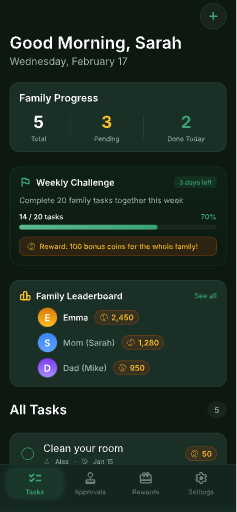
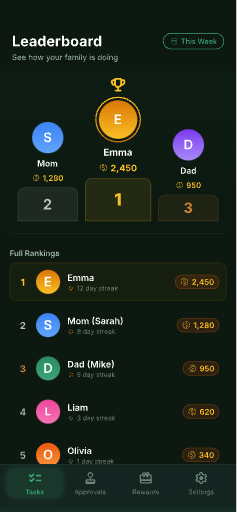
The leaderboard ranks family members by coins earned, tasks completed, and current streaks. Kids can see who's leading and what it takes to catch up. The streak system tracks consecutive completions, maintaining a streak is its own motivation.
Evidence-Based Task Completion
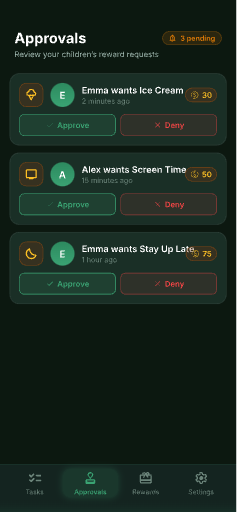
Parents can require proof that a task was actually done. Kids submit photo, video, or text evidence when marking complete. The submission goes to the parent's Approval Queue for verification before coins are awarded. Solves the "I already did it" problem.
Under the Hood
Key Technical Decisions
TCA Template, Zero to Feature Modules
Started with my production-ready TCA template, pre-configured architecture, multi-environment schemes, Arkana secrets, SwiftLint/SwiftFormat, and pre-commit hooks. Instead of weeks on boilerplate, I was scaffolding features on day one.
Real-Time Family Data with Supabase
Family apps need instant updates, when a kid completes a task, parents should see it immediately. Chose Supabase for PostgreSQL foundation, Row-Level Security for family isolation, and real-time subscriptions. More data model control than Firebase.
Gamification as a State Machine
The coin/XP/streak/level system is a state machine with rules, not UI decoration. Coins are transactional with full history. Streaks track per-task consecutive completions. All modeled in the Domain layer, you can't spend coins you don't have, streak breaks are permanent.
What I Learned
Gamification Design Is Harder Than the Code
Building the coin/XP/streak system was straightforward engineering. Balancing it so kids stay motivated without gaming the system? That's product design. How many coins per task? What's the right reward cost? I spent more time tuning the economy than building it.
Templates Are a Multiplier, Not a Shortcut
My TCA template saved weeks of setup time, but it only works because I built it from real project experience. It encodes decisions about package structure, dependency rules, testing patterns, and quality gates refined across multiple projects.
Role-Based Access Is a Day-One Decision
I originally planned to add parent/child roles later. That lasted two days before I realized every feature branches on who can see and do what. Building the role system first made every subsequent feature cleaner.